
Approximately 3 million people worldwide die annually from out-of-hospital cardiac arrest. Cardiopulmonary resuscitation maneuvers and early defibrillation have been proven to be of benefit in this matter. Performing this technique in the first 3-4 minutes after cardiac arrest improves victims’ survival chances by over 50%.
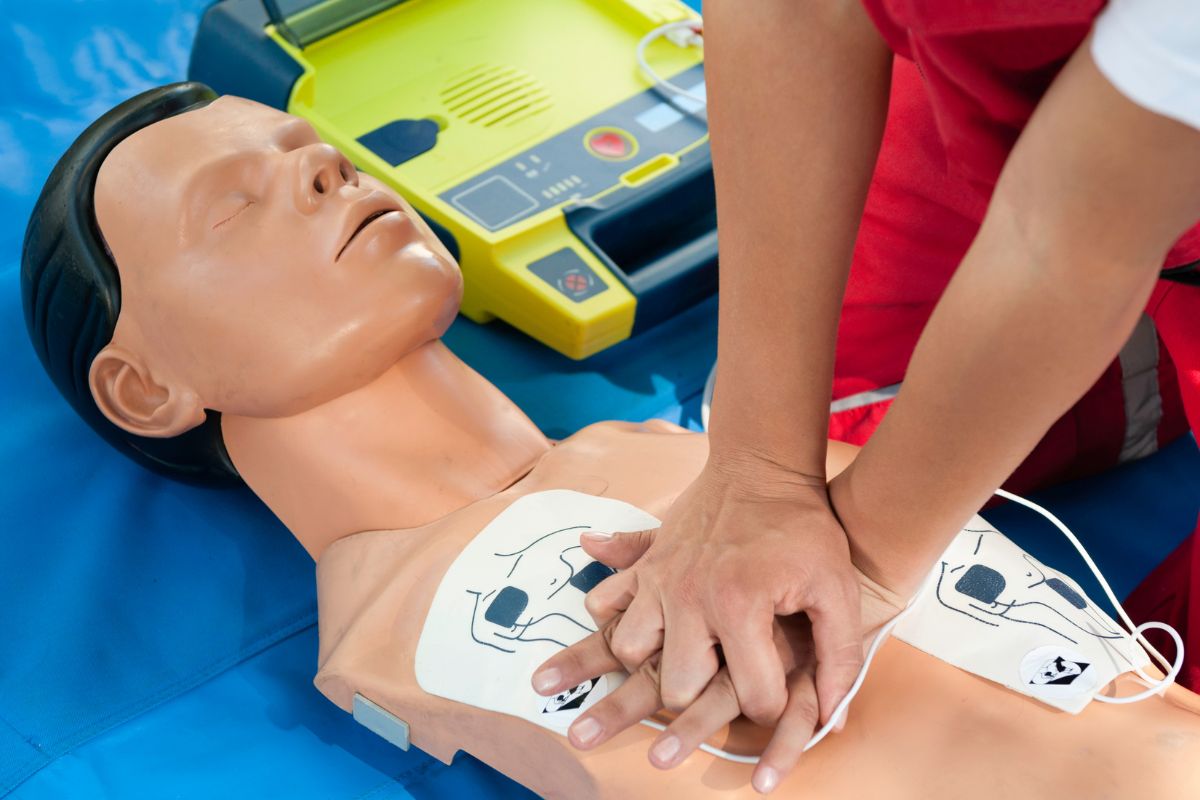
Our training seeks to instruct students in Basic Life Support (BLS) techniques and in the use of an Automated External Defibrillator (AED), training them as first responders in the chain of survival and thereby increasing the number of people able to care for victims of cardiac arrest.
Our courses provide the knowledge, skills, and abilities necessary to recognize life-threatening situations and to act immediately according to the guidelines proposed by the European Resuscitation Council (ERC).
The courses are face-to-face, adapted to different population groups and taught by specialized health personnel.
To provide the greatest comfort to our students, we travel to their facilities, offering flexible dates and schedules. We have all the necessary equipment, including mannequins and other training devices.
Physicians Specializing in Anesthesiology, Resuscitation and Pain Management
Surgical nurses, experts in CPR

Surgical nurses, experts in CPR
CPR and AED trainers accredited by the National CPR and ERC Plan
Members of the Spanish Society of Anesthesiology and Resuscitation (SEDAR)

1.5-2 hours face-to-face

4-8 hours face-to-face

4-8 hours face-to-face

8 hours face-to-face
8 hours face-to-face

15h online and 9h face-to-face
In this section you will find answers to the most frequently asked questions about our training
First aid is a series of techniques and actions for attending to a victim with injuries or illnesses that are not imminently life-threatening.
The objective is to stabilize the victim's physical condition until specialized medical assistance arrives.
BLS is the set of maneuvers that make it possible to identify whether a person is suffering cardiorespiratory arrest and, if so, to perform a temporary replacement of respiratory and circulatory functions, without any specific equipment, until the victim can receive specialized medical care.
The objective is to provide supplemental oxygenation to tissues to minimize damage to the brain and other vital organs.
BLS maneuvers should be initiated as early as possible, are easy to learn and
can be performed by anyone with proper training.
The emergencies that most frequently require BLS maneuvers are cardiorespiratory arrest, choking, drowning, electrocution, asthmatic crisis, heat stroke, and alcohol or drug intoxication, as well as any situations in which the victim is unconscious.
Anyone interested in acquiring the minimum knowledge to be able to act in the event of a cardiorespiratory arrest or imminent life-threatening situation.
The courses are structured in two parts. First, there is a theoretical part discussing the main concepts for performing basic life support techniques. This is followed by a second practical part, where the student will work with different mannequins, the AED, and other devices.


UPROMEDES (Unidad de Profesionales de Medicina Especializada S.L.P.) is a professional society adapted to the law 2/2007 of professional societies and registered in the Mercantile Registry of Valencia: T 9274, L 6557, F 209, S 8, H V 141987, I/A 2 (10/06/2011).

